The Ultimate Guide to Updating Your Bomb Shelter
In Singapore, bomb shelters are a familiar sight in every HDB flat built since 1998. These sturdy, reinforced spaces, mandated by the Singapore Civil Defence Force (SCDF), are designed to provide safety during emergencies.
In everyday life, though, most of them end up as a dumping ground. Cleaning supplies shoved in without thought, luggage stacked precariously, the whole space sealed off by a heavy metal door that looks out of place in an otherwise well-designed home. It’s a missed opportunity, because with a bit of planning, the bomb shelter can be one of the most functional corners of your flat.
This guide walks you through how to transform your bomb shelter into a proper storage space, how to conceal that door so it stops clashing with your interiors, and a few important things to keep in mind along the way.
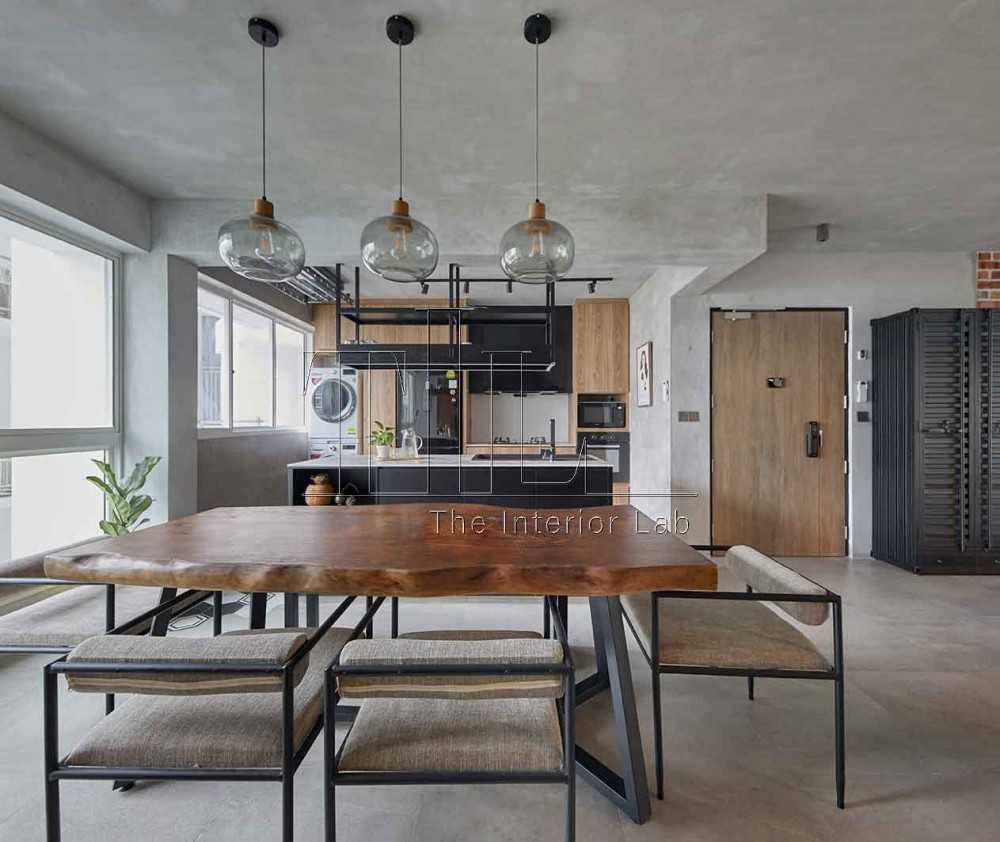
Sumang Walk ($58,000) by D5 Studio Image Pte Ltd
Understanding What You Are Working With
Bomb shelters, or household shelters as the SCDF formally calls them, were made mandatory in Singapore’s HDB flats as part of the country’s civil defence framework. Their primary function is protection during emergencies, and everything about their construction reflects that: thick reinforced concrete walls, a heavy blast-resistant door, and limited ventilation designed for short-term use rather than daily living.
In terms of size, most shelters range from about 1.5 to 3 square metres. It’s not much, but it’s workable if you approach it the right way. The constraints worth knowing upfront are the door, which swings inward and can’t be removed or permanently altered, and the ventilation sleeves, which are built for emergency airflow only. These two things shape most decisions about what you can and can’t do with the space.
Planning the Update: Start With a Clear Goal
Before buying shelves or calling a carpenter, it helps to decide what you actually want the space to do. For most homeowners, the answer falls into one of two camps: maximising storage inside, dealing with the door on the outside, or both.
A practical starting point is to take stock of what you currently store there, or what you wish you could store there. Vacuum cleaners, luggage, festive decorations, pantry overflow, cleaning supplies — these are common choices. Knowing this helps you figure out what kind of shelving or organisation system will actually serve you, rather than buying something generic that doesn’t quite fit.
On the exterior side, the goal is usually to make the door less of an eyesore. Whether your flat leans Scandinavian, industrial, or contemporary, there are ways to incorporate the door into your overall design rather than leaving it as an obvious outlier.
Budget considerations
Costs vary quite a bit depending on how far you want to go. Basic off-the-shelf shelving typically runs between S$100 and S$300. Custom carpentry to conceal the door is a bigger investment, usually between S$1,000 and S$3,000 depending on the complexity of the design and the materials used. If budget is a concern, a sensible middle ground is to handle the interior storage yourself with modular units, then engage a carpenter just for the door facade.
DIY versus hiring a professional
Interior storage is well within DIY territory for most people. Modular shelving, hooks, and stackable bins require no special skills and can be reconfigured easily if your needs change. The exterior is a different story. Any carpentry that involves concealing the door needs to allow full, unobstructed access in an emergency, which means it has to be designed correctly. A carpenter familiar with SCDF guidelines will know what’s allowed and how to make it work without compromising compliance.
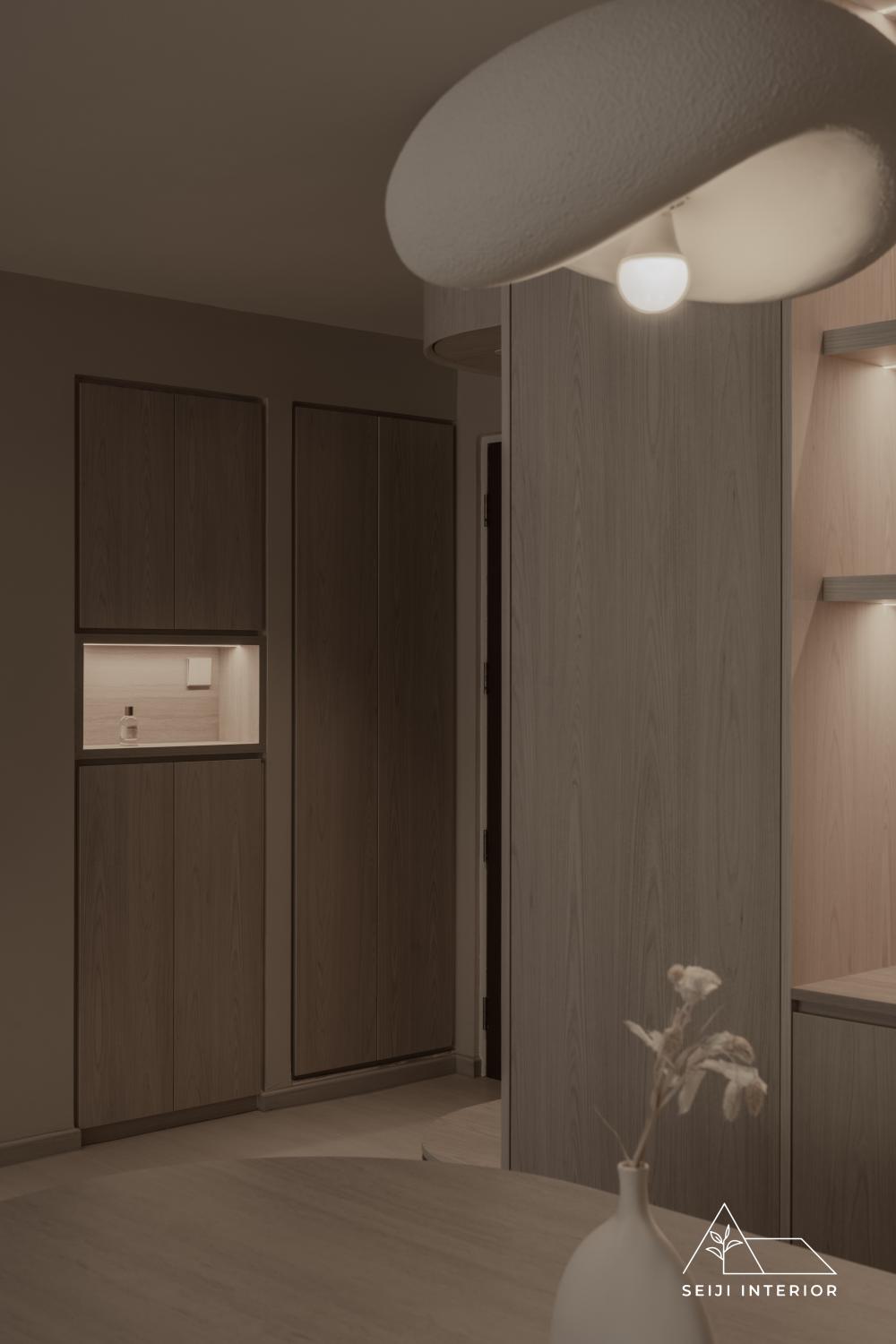
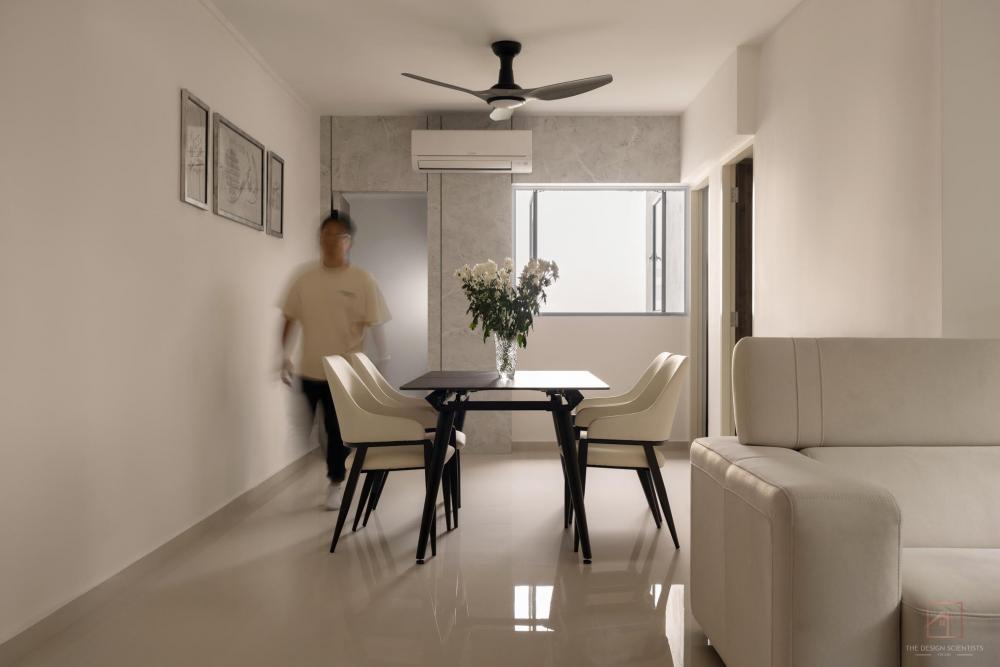
306A Tengah ($60,000) by Seiji Interior
Smart Storage for the Interior
The small footprint of a bomb shelter means every design decision needs to earn its place. The following approaches make the most of the limited space without making it feel chaotic.
Modular shelving
Adjustable modular shelving is the most versatile option because you can reconfigure it as your storage needs shift. Look for units with a depth of around 30 to 40 cm, which suits the narrow dimensions of most shelters. IKEA and FortyTwo both carry lightweight options that work well here. The key advantage of modular over built-in is flexibility: if you need to clear the shelter quickly in an emergency, modular units are easier to work around.
Using vertical space
Floor space is limited, so the walls are worth using. Wall-mounted hooks can hold mops, brooms, reusable bags, and other awkward-shaped items that don’t sit well on shelves. Under-shelf baskets are useful for lightweight items like cleaning cloths or batteries. If your ceiling height allows, a top shelf running the full width of the shelter gives you somewhere to stash things you rarely need, like seasonal decorations or spare luggage.
Foldable racks and stackable bins
For bulkier items like suitcases or a vacuum cleaner, a foldable rack keeps things accessible without permanently eating into your floor space. Stackable plastic bins or wire baskets work well for smaller items, and labelling them saves a lot of rummaging. Clear bins are particularly useful if you have multiple categories of items stored together.
Choosing the right materials
Singapore’s humidity is worth factoring in. Powder-coated steel and high-density plastic both hold up well in the typically warmer, less-ventilated environment of a bomb shelter. Untreated wood is risky — it can warp or develop mould over time in a space with limited airflow. If you prefer a warmer look, opt for moisture-treated wood or wood-effect alternatives.
Many people also place a dehumidifier product like Thirsty Hippo inside the shelter to manage moisture buildup. It’s a simple, low-effort step that can make a real difference, especially if you’re storing items that are sensitive to humidity like documents, clothing, or electronics.
Keep emergency access clear
It’s absolutely fine to use your bomb shelter for storage — that’s what most Singaporeans do. The line to watch is whether the space has become so packed that your whole household can no longer fit inside together. In a genuine emergency, the shelter needs to be usable by everyone in the flat, so while filling the shelves is fine, filling every square centimetre of floor space is not. Keep a clear, usable area in the middle, and make sure you can get the door shut behind you.
Concealing and Updating the Exterior
The door is probably the trickiest part of the whole project. It’s heavy, metal, and designed to stand out from a structural standpoint, none of which helps when you’re trying to create a cohesive interior. Fortunately, there are a few solid approaches depending on what your overall design looks like.
Custom carpentry
Since the bomb shelter is typically located near the entrance of the flat, it often sits in or adjacent to the entryway or living area. This actually gives you quite a bit of design flexibility. A common approach is to build a false wall or panel system that runs along the entrance corridor, with the shelter door integrated as a flush panel that blends into the surrounding wall.
Alternatively, some homeowners use the space around the door for a built-in shoe cabinet or storage unit, which does double duty by adding useful storage near the entrance and drawing the eye away from the door itself.
Whatever carpentry approach you go with, the door must be able to open fully and without obstruction at all times. A carpenter experienced with SCDF requirements will design for this from the start, so be upfront about it when getting quotes.
Paint and surface finishes
If custom carpentry isn’t in the budget, a fresh coat of paint goes a long way. Neutral tones like white, warm grey, or beige help the door recede visually and stop drawing the eye. Use moisture-resistant, non-flammable coatings — Nippon Paint and Dulux both have suitable options for Singapore’s climate. Make sure whatever you use is SCDF-compliant.
For something with a bit more character, wallpaper, wood veneer panels, or vinyl decals can be applied to the door surface or the surrounding wall. Geometric patterns suit modern interiors; woodgrain textures work well for warmer, cosier aesthetics. As with paint, check that any materials used are compliant and can be removed if needed.
Drawing attention away from the door
Sometimes the best approach isn’t to hide the door directly, but to give the eye something more interesting to look at nearby. Flanking the shelter entrance with built-in shelves, a shoe cabinet, or a display nook shifts focus and makes the whole area feel intentional. These additions also add functional storage or display space, so they’re doing double duty.
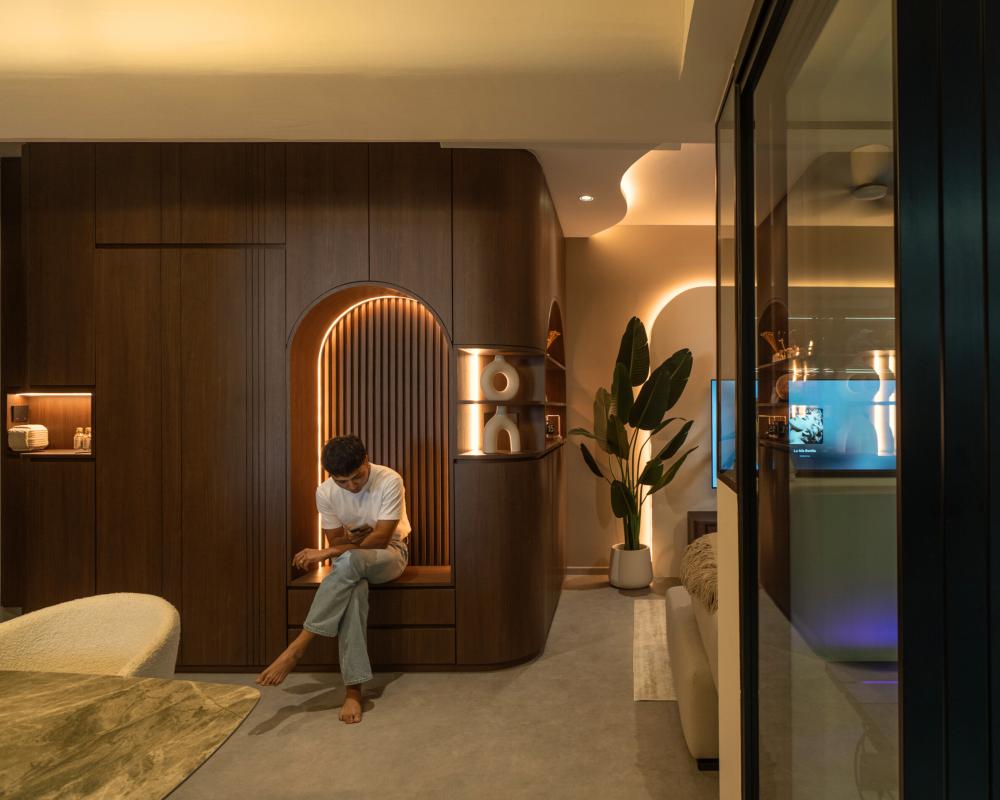
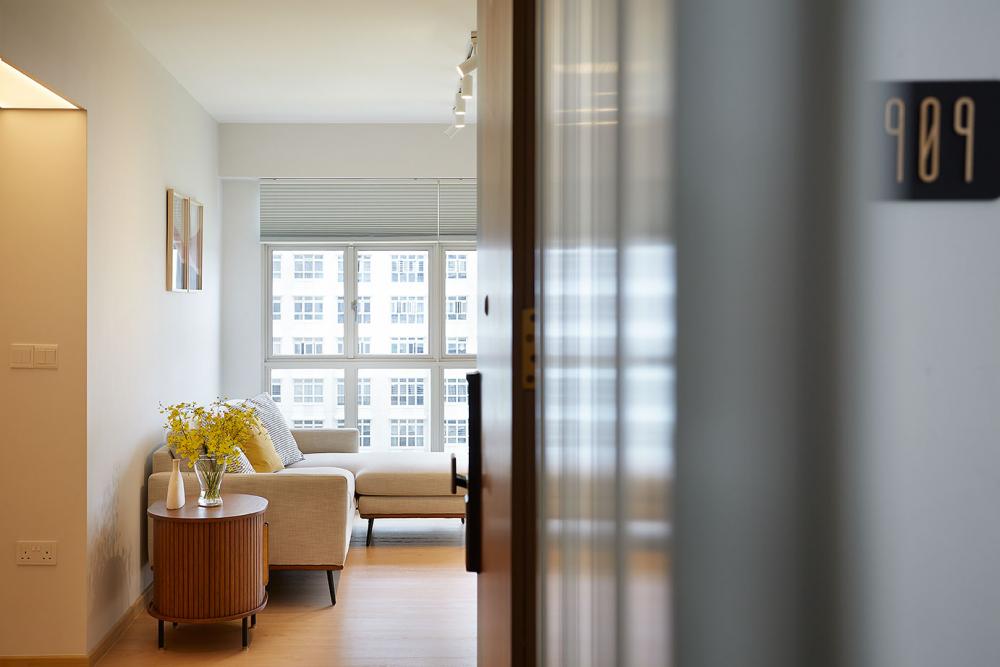
Champions Green ($50,000) by Design 4 Space Pte Ltd
The Helper’s Room Debate: What You Should Know
One question that comes up regularly in Singapore home renovation forums is whether the bomb shelter can be converted into a helper’s room. After all, space is tight in most HDB flats, and the shelter can feel like wasted square footage. Some homeowners do go ahead with it, removing the original blast-resistant door and replacing it with a louvred door to improve airflow.
The problem is that the shelter was never designed for daily habitation. Ventilation is genuinely poor: the sleeves are built for emergency use, not the kind of sustained airflow a person needs living in a space through Singapore’s heat and humidity. Even with a louvred replacement door, many residents find the room uncomfortably warm and stuffy.
Beyond comfort, there’s the issue of purpose. A bomb shelter filled with furniture, a bed, and personal belongings can’t realistically be cleared and used as an emergency shelter when needed. This compromises the safety function the space was built for, which isn’t a minor concern.
There are also legitimate ethical questions about whether a small, enclosed room with limited ventilation and no natural light is an appropriate long-term living space. If providing a helper with decent accommodation is the goal, it’s worth exploring options other than your bomb shelter.
Staying Compliant With SCDF Guidelines
Throughout any update to your bomb shelter, SCDF compliance is non-negotiable. The key requirements are straightforward: the door must remain functional and accessible at all times, the structural integrity of the shelter must not be compromised, and any modifications must be reversible if needed.
In practice, this means no permanent fixtures that block the door, no drilling into or altering the blast-resistant walls, and nothing that would prevent the shelter from being used in an emergency. Custom carpentry that panels over the door is generally fine as long as it allows full access. What you want to avoid is anything that would make opening the door difficult or slow in a high-stress situation.
If you’re in any doubt about a specific modification, the SCDF website provides guidance, and any reputable interior designer or contractor familiar with HDB renovations should be able to advise you.
Making the Most of the Space You Have
The bomb shelter is one of those features that most Singaporean homeowners quietly accept as a necessary inconvenience. But it doesn’t have to be an afterthought. With the right storage system inside and some thought put into the exterior, it can be a genuinely useful part of your home rather than a space you just ignore.
The sweet spot is an interior that’s organised and accessible, a door that doesn’t disrupt your home’s visual flow, and everything done in a way that keeps the shelter ready to serve its actual purpose when it counts. That balance is entirely achievable, and in a compact HDB flat, good use of every square metre makes a real difference to how the home feels to live in.
Want to check out home renovation projects for more inspiration? Browse interior design ideas on Hometrust, or click the button below to get connected with expert designers!
Renovating soon? Let Hometrust recommend the best interior designers.
If you are reading this, you are probably wondering how you can create your dream home.
Here’s the thing, everyone’s needs and requirements for their home renovation is different. A designer that may work for someone else, may not quite work for you.
At Hometrust, we’re here to help match top rated designers, recommended by past homeowners to you through our data-driven and matching algorithm.
Whether you are looking for partial renovation or a full fledge overhaul, we’ll be able to recommend you top designers to match your renovation requirements and lifestyle.
Recommendations and free and you can simply start by helping us understand your needs below!
Get RecommendationsRenovate safe!
The Hometrust Team